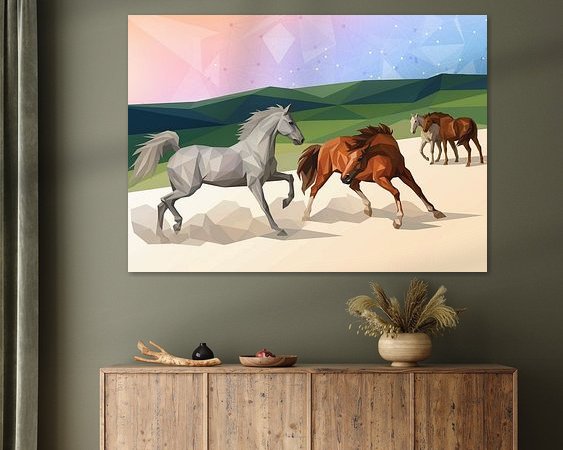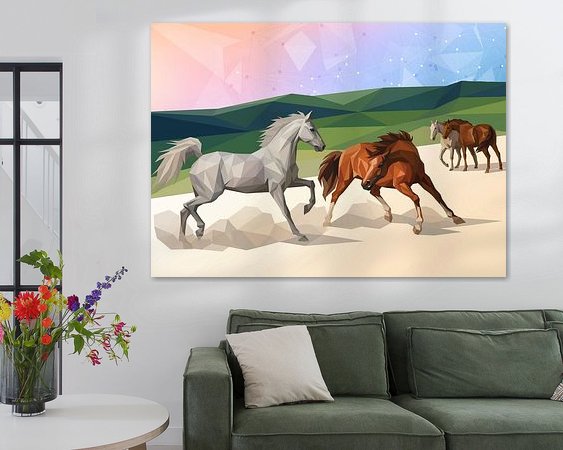









"Horses" (style Low poly) inspiration from a painting by Basuki Abdullah
Basuki Abdullah is often celebrated for his mastery of Western academic realism and his ability to merge it with Indonesian visual sensibilities. In his painting Horses, this synthesis becomes especially compelling. The work presents powerful horses…
"Horses" (style Low poly) inspiration from a painting by Basuki Abdullah
Basuki Abdullah is often celebrated for his mastery of Western academic realism and his ability to merge it with Indonesian visual sensibilities. In his painting Horses, this synthesis becomes especially compelling. The work presents powerful horses colliding across an expansive landscape — energetic, dramatic, and emotionally charged.
At first glance, the painting may appear to be a straightforward celebration of strength and beauty. Yet the symbolism of horses within Indonesia’s colonial history invites a deeper interpretation.
During the Dutch colonial period, horses were more than animals of transport or labor. They frequently represented prestige, authority, and elite status. Ownership of horses was closely associated with colonial officials, aristocratic circles, and wealthy members of society. In this context, horses became visual markers of hierarchy and power.
Abdullah, who was academically trained in the Western tradition, would almost certainly have understood these cultural and political associations. This raises an intriguing question: was Horses merely an aesthetic exercise, or did it subtly challenge the structures of colonial authority?
What makes the painting particularly interesting is the way the animals are depicted. These are not calm, obedient horses serving imperial order. Instead, they appear wild, forceful, and untamed — resisting control rather than embodying it. The tension within the composition opens space for interpretation. It suggests the possibility that Abdullah was engaging, consciously or unconsciously, with broader questions of power, domination, and freedom in postcolonial Indonesian society.
The absence of a precise date for the painting further complicates the reading. Without a clear historical placement, the artwork resists easy categorization and encourages viewers to think critically about the shifting political and cultural environment in which it may have been produced.
To understand works like Horses more fully, we must move beyond visual analysis alone. Colonial archives, contemporary art criticism, exhibition histories, and biographical studies all play an important role in uncovering the institutional and social forces that shaped artistic production during the period.
Art is never created in isolation. Every painting carries traces of the historical realities, political tensions, and cultural negotiations of its time. Revisiting Basuki Abdullah’s work through this lens allows us not only to appreciate its technical brilliance, but also to reconsider the layered narratives embedded within Indonesian modern art.
Dein Lieblingskunstwerk auf hochwertigem Textildruck, gespannt in einem Aluminium- oder Holzrahmen. Der Textildruck lässt sich schnell und einfach austauschen. So erzeugst du im Handumdrehen eine neue Atmosphäre in deinem Zuhause, ganz nach deinem Geschmack.
Handverlesene Tipps, Trends und Ideen für dein Zuhause, direkt in dein Postfach.
Entdecke unsere Kunstwelt – eine Abmeldung ist jederzeit möglich. Nach der Bestätigung deiner Anmeldung erhältst du deinen Rabattcode in der ersten E-Mail.